
Preparing in a small flat: what to store and where to put it
You want to be better prepared at home, but the cupboard is full and your emergency bag is still in the hallway. In a small flat, what matters is making room for supplies you can reach in the dark or when you need to leave quickly.
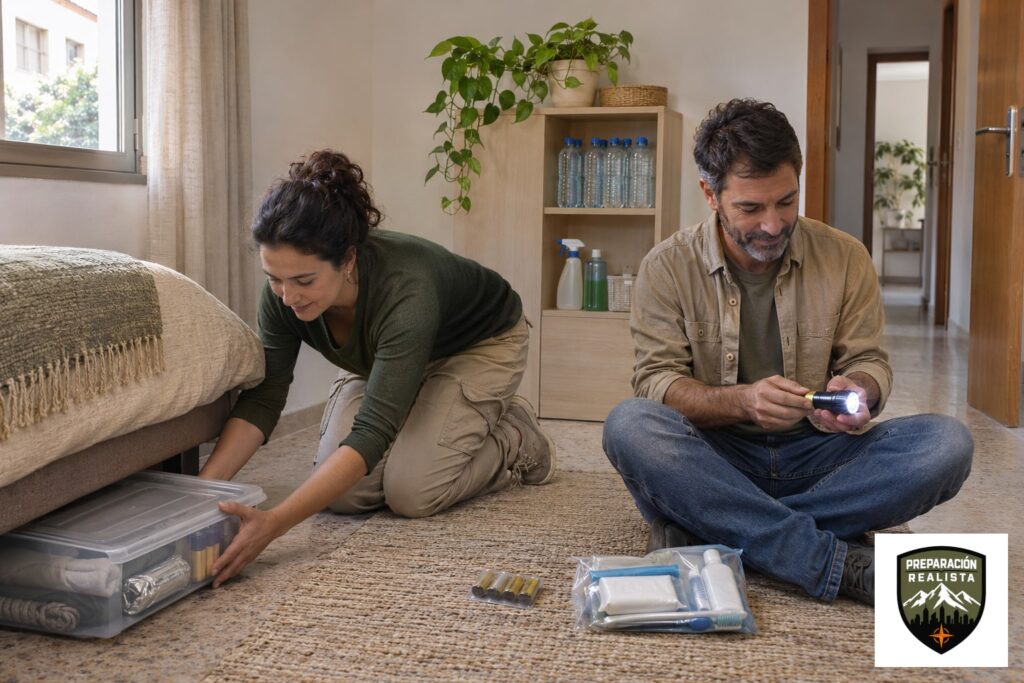
Start with supplies you have room to store, can look after and know how to use. If you have to move a stack of boxes to find the torch, another box is unlikely to help.
Start with doors and clear routes
Walk from the bed to the front door and along the routes you use every day. Check that doors open freely and that there is room for a walker, pushchair or wheelchair. Do this in good light and leave any mobility aids where people need them.
The U.S. Fire Administration recommends keeping escape routes clear and planning how to help anyone who may need support. Use the same principle when deciding where to put emergency supplies.
Keep supplies within your flat and avoid using shared landings, stairs or space outside a neighbour’s door. Ask the building manager if you’re unsure about shared areas. Move any bag that obstructs an exit.
Give frequently used items a different home from spares
A torch should be easy to find immediately. Some spare batteries or tools can go somewhere less prominent. The food you keep in reserve can sit alongside the food you use every day if you rotate it regularly.
| What you need | Where you might put it | What to check |
|---|---|---|
| Immediate use, such as a torch and contact details | A familiar, accessible drawer | Everyone knows where it is and can open it without moving furniture. |
| Food and water | A suitable part of the cupboard and low, sturdy storage | Storage conditions, weight limits and separation from cleaning products. |
| Spares and small tools | A labelled box in a cupboard or under the bed | Access, damp and the storage instructions for each item. |
| Things to take if you leave | A designated place clear of the exit route | You can pick them up without blocking the door or needing help. |
Store medicines as directed for each treatment and keep them out of children’s reach. Keep them in their original packaging and check their storage requirements before putting them in a bathroom cupboard or an under-bed box.
Measure the space before you buy a box
Measure the available height, depth and width. Allow for the lid, handles and room to pull the box out. Check both the external and internal dimensions. A container you can easily move when it’s empty may be too heavy once full.
The 33-litre Really Useful Box on Amazon is one low-profile option. The manufacturer lists external dimensions of 71 × 44 × 16.5 cm. Measure around the bed frame as well as beneath it to see whether a box will slide in and out.
Match the contents to the conditions. A lid alone offers limited protection from water, heat or knocks. Find another place for anything that needs to stay dry if the space is damp.
Try reaching and pulling out the box. A drawer at a comfortable height may work better for someone with limited mobility. Our guide to preparing with limited mobility (in Spanish) has more ideas.
Spread the weight and keep the original labels
Check how much the shelf can hold before loading it with water, tins and tools. Follow the furniture and fixing instructions. Store heavy items where they are stable and you can lift them comfortably. Keep anything urgent within reach without standing on a chair.
Arrange food so you can see what you have and use what expires first. Keep the labels, allergen information and storage instructions. Use containers intended for direct food contact if you plan to store unpackaged food.
Choose water containers you can carry and store. The guide to storing water in a flat (in Spanish) covers that part of the plan. Keep drinking water and food away from cleaning products, fuels and anything that could contaminate them.
Label boxes so someone else can find things
“Torches and batteries”, “Hygiene” or “Documents” is clearer than “Emergency 3”. Add a check date if it helps and a brief list of contents if the box is opaque. Use lettering everyone can read and keep personal details inside.
A DYMO LetraTag LT-100H label maker on Amazon can help if you’re organising several boxes. A handwritten label works too. Check which tapes are included and which refills fit before buying.
Affiliate disclosure. As an Amazon Associate I earn from qualifying purchases.
Test whether someone can find what they need
Ask someone at home to find the torch and a copy of the household plan without hints. Then see if they can pull out a box, check what’s inside and put it back. Try it in daylight and keep the exits clear.
For a fuller plan, see Supervivencia urbana, the Preparación Realista book (in Spanish). Keep the supplies that solve a problem for your household and fit in a space you can look after.
One thing to do this week: clear one route, measure one space and organise a small box using things you already own. Try using it before you buy another organiser.